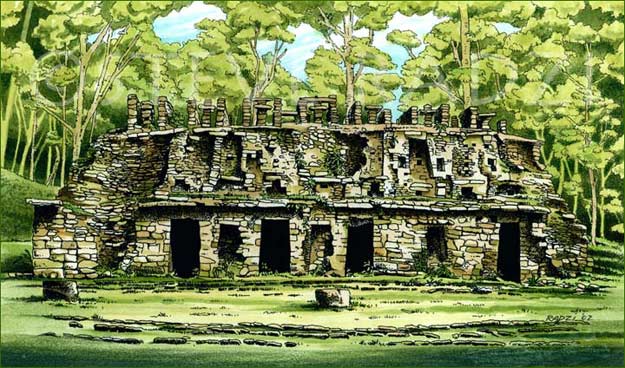

In
1992 I had the wonderful opportunity of spending some time in Central
America. One of the highlights of that trip was the incredible journey
I took by way of dugout canoe. I started from Sayaxche, in Guatemala
and traveled along the Pasion River, stopping at Altar de Sacrificios
on the way. From there, I headed down the grandest of all Maya rivers,
the Usumacinta, to the Classic Maya site of Yaxchilan, located on the
banks of a horseshoe peninsula on the Mexican side of the river.
This magnificent site has the qualities of a real Middle Earth. We arrived
in the darkness of early evening and after scrambling and slipping up
the steep, muddy bank, we made the jungle our home for a couple of days
with hardly a visitor on site.
Fortunately, much of the architecture at Yaxchilan (Green Stones)
has survived the ravages of time and the site is well documented by
such renowned scholars as Carolyn Tate, Linda Schele and Ian Graham
whose writing and superb illustrations are a valuable record of the
citys importance. Although many of the important lintels have
been moved from the site to the museum in Mexico City and to the British
Museum in London, many still remain.
It is well worth researching the history of Yaxchilan before making
a trip to this site, because of the sheer amount of glyphic text and
visual documentation on the stelae and lintels. The life and times of
rulers such as Shield Jaguar and his son Bird Jaguar, along with their
wives with lovely names such as Lady Xoc and Lady Great Skull Zero are
vividly portrayed.
The Hieroglyphic inscriptions provide us with a wealth of information
regarding the royal lineage from births, accessions, bloodletting ceremonies,
the capture of important political enemies as well as sacrificial ceremonies
and eventual deaths on the monuments of Yaxchilan. I spent quite a bit
of time scribbling in the rain and listening to the birds and the not
too distant howler monkeys hanging about in the forest canopy.
Today, Yaxchilan is much more accessible than in years past, replete
with concrete boat ramp and ticket booth. Although, when visiting there
in 2001, we confronted the constant arrival and departure of motor launches
full of tourists, the ruins are still a majestic testimonial to one
of the great cities of Maya Culture.